

Stress-test your whole portfolio. Crypto included.
A Claude-powered analyst reads any name, a six-signal gate reads the regime, and a real backtester stress-tests the whole book — equities, crypto, FX, and commodities in one cockpit. Built to manage risk, not promise winners. Founding members lock all of it in for life for a one-time $200 — and the price rises as seats fill.
14-day money-back guarantee
Analysis & monitoring only — not investment advice.
- NVDA+2.4%
- BTC+1.1%
- XLE-0.8%
- EURUSD+0.3%
Your money is multi-asset. Your tools aren't.
Stock screeners ignore your crypto. Crypto apps ignore your equities. Backtesters have no monitoring, and nothing watches the whole book the way it actually moves together. Finisdom does.
An AI second opinion + a regime radar
Claude reads the fundamentals and quant pillars on any name, while a six-signal deployment gate reads risk-on / risk-off across the whole tape. A second opinion and a regime radar — not a crystal ball.
Every asset, one cockpit
Equities, ETFs, crypto, FX, and commodities side by side — not three apps and a spreadsheet. See the whole book the way it actually moves.
Built for risk discipline
A real backtester and efficient frontier, plus drawdown, up/down capture, regime splits, correlations, and a decision journal — designed to keep you on-plan, not to promise winners.
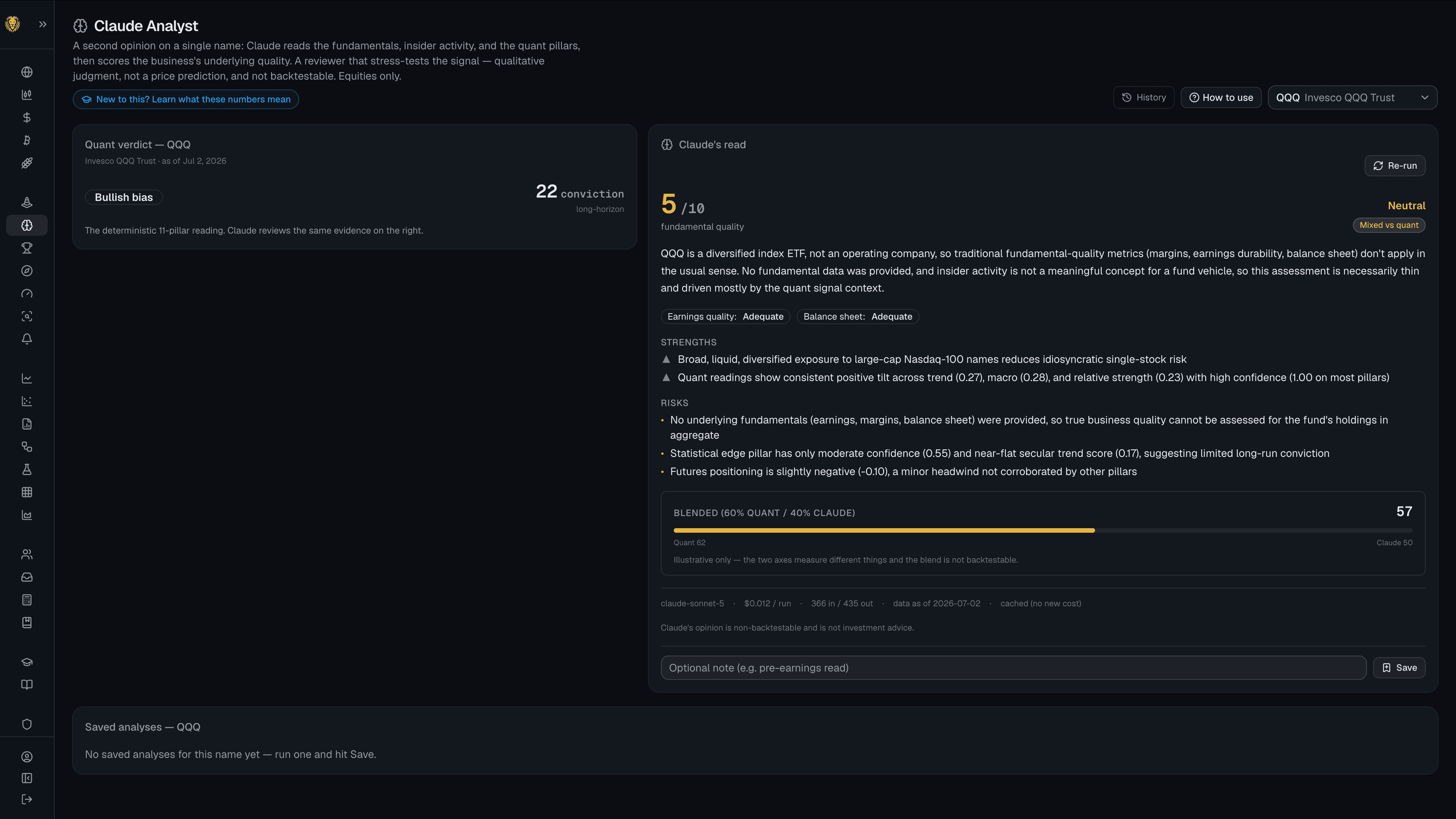
A second opinion from Claude on any name
Claude reads the fundamentals, insider activity, and the quant pillars, then scores the business’s underlying quality — and tells you exactly where it disagrees with the signal. A reviewer that stress-tests the read, not a price prediction.
- Strengths, risks & red flags in plain English
- Blends an 11-pillar quant read with Claude’s judgment
- Every run saved to a per-name history
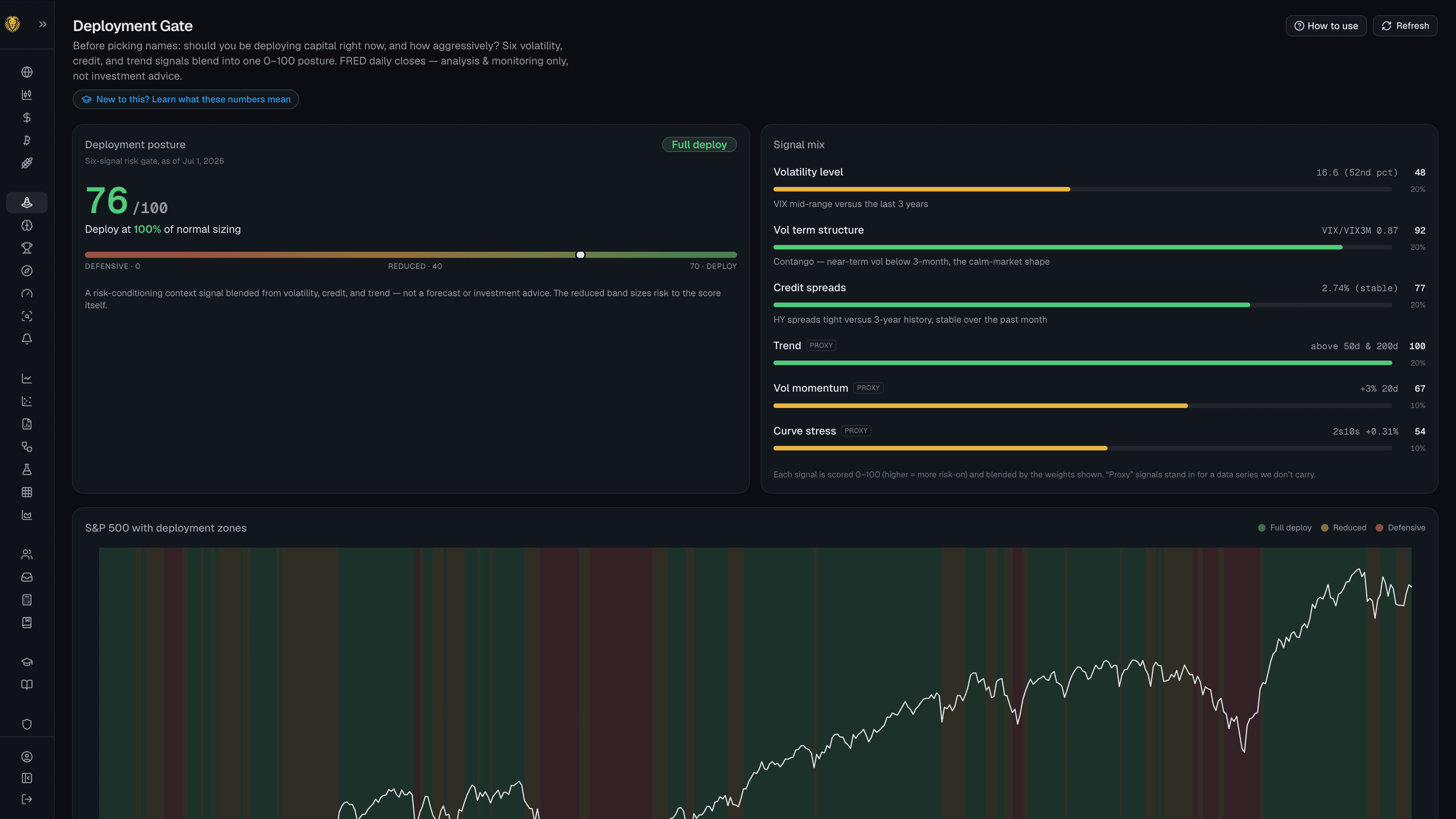
Know how aggressively to deploy — before you pick names
Six volatility, credit, and trend signals blend into one 0–100 posture, mapped onto the S&P 500 with defensive, reduced, and full-deploy zones. A risk-conditioning read on the whole tape — not a forecast.
- Six-signal blend (VIX, term structure, credit, trend…)
- 0–100 posture with position-sizing bands
- FRED daily closes — analysis & monitoring only
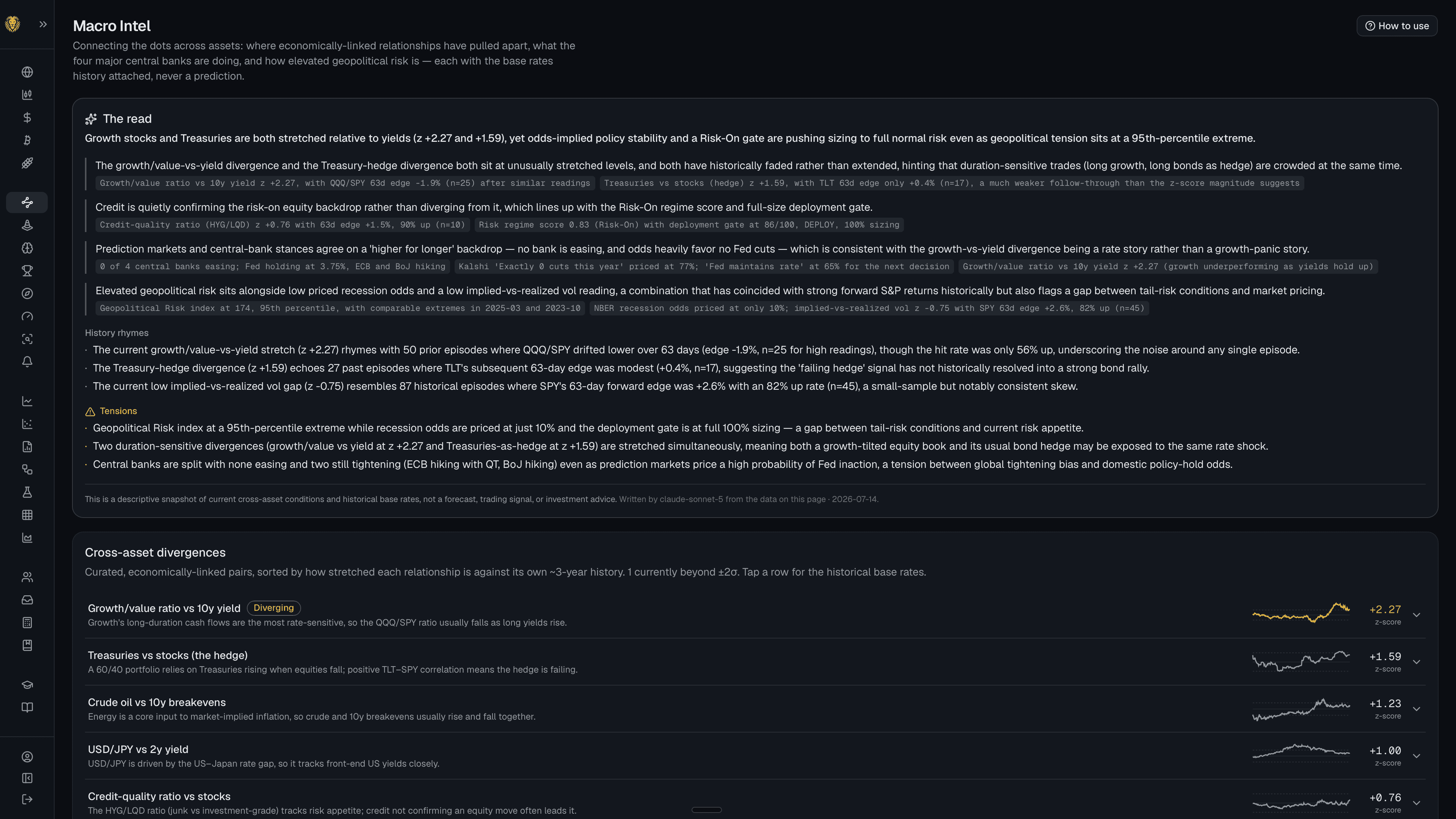
Connect the dots the single-asset view misses
A dozen economically-linked pairs — gold vs real yields, credit vs stocks, the 60/40 hedge — scored against their own ~3-year norm, so you see which relationships have pulled apart. Claude reads the whole board daily and names the tensions in plain English, with the base rates of what history did next.
- Z-scored divergences with the base rates attached (n and edge shown)
- Central-bank tracker + the Caldara–Iacoviello geopolitical-risk index
- Says when the evidence conflicts — conditions, never a forecast
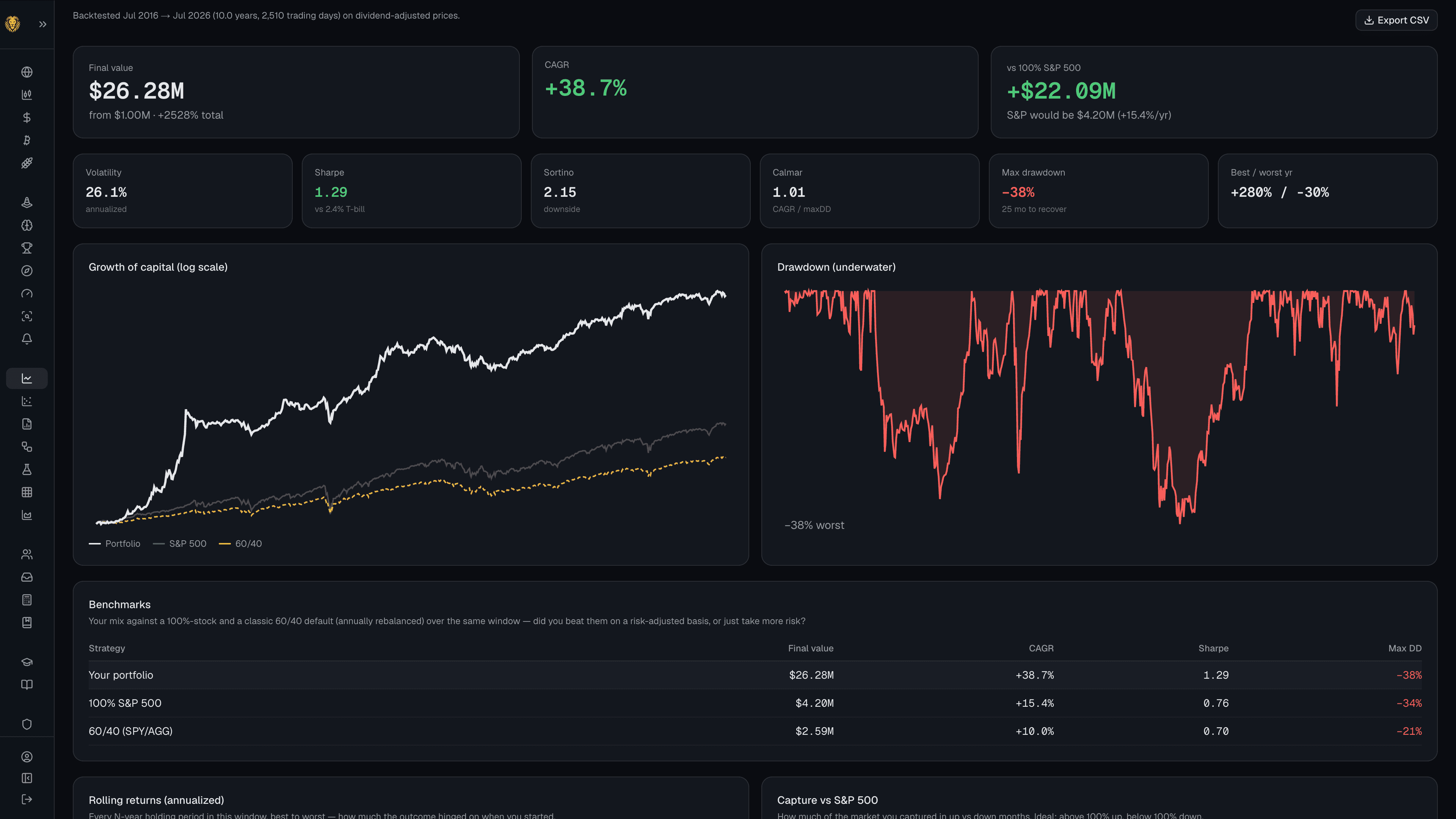
Backtest the whole portfolio in seconds
Build any allocation with rebalancing rules and get Sharpe, Sortino, Calmar, max drawdown, rolling returns, and up/down capture — benchmarked against 100% SPY and 60/40, split by bull and bear regimes.
- Historical crash stress tests
- True risk-free Sharpe (FRED)
- CSV export & saved portfolios
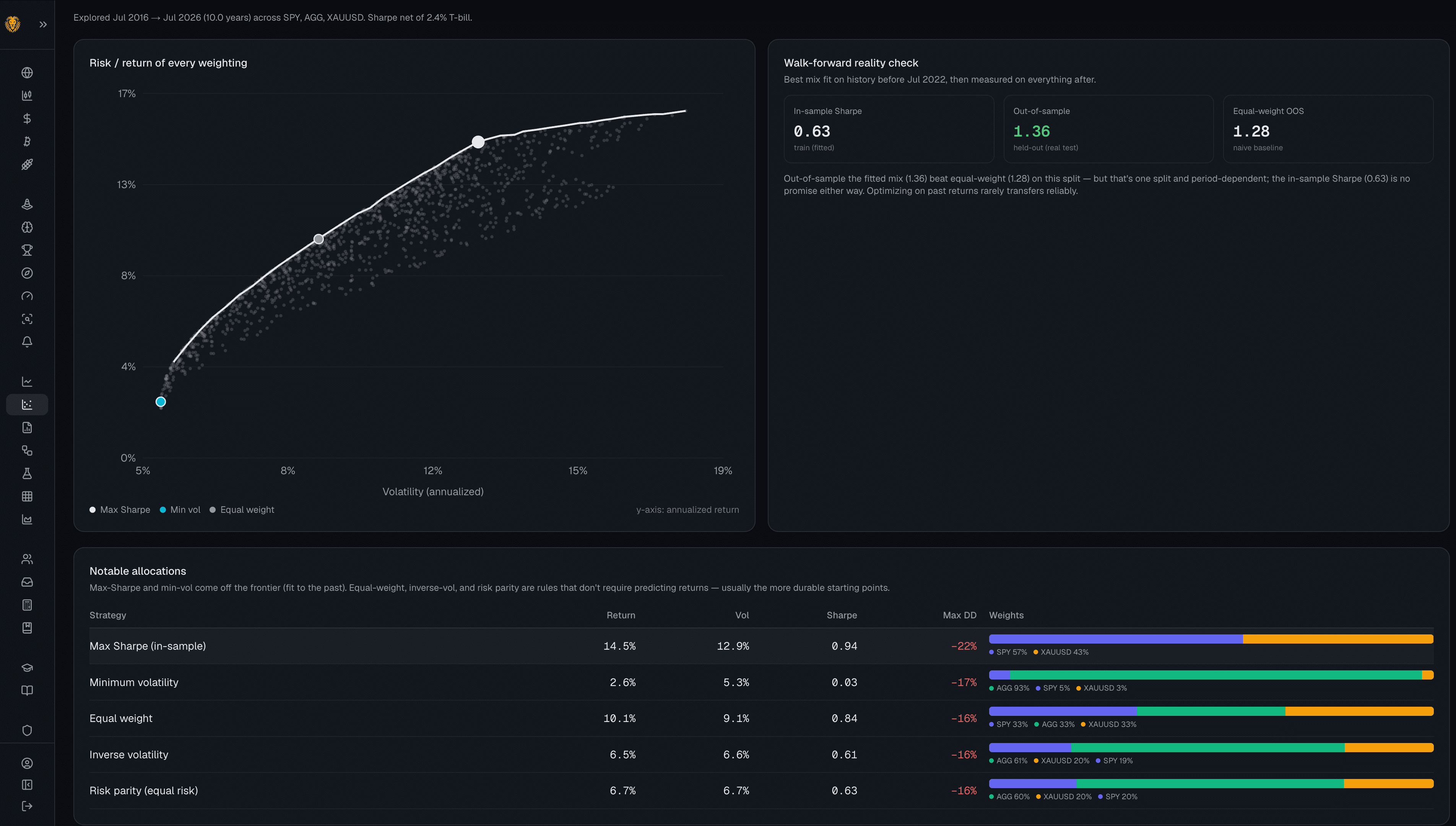
Optimize on the efficient frontier
Trace the frontier, then compare max-Sharpe, min-vol, equal-weight, inverse-vol, and ERC risk-parity allocations — with honest walk-forward so you see out-of-sample behavior, not a curve fit.
- Max-Sharpe & min-vol
- Risk-parity (ERC)
- Walk-forward validation
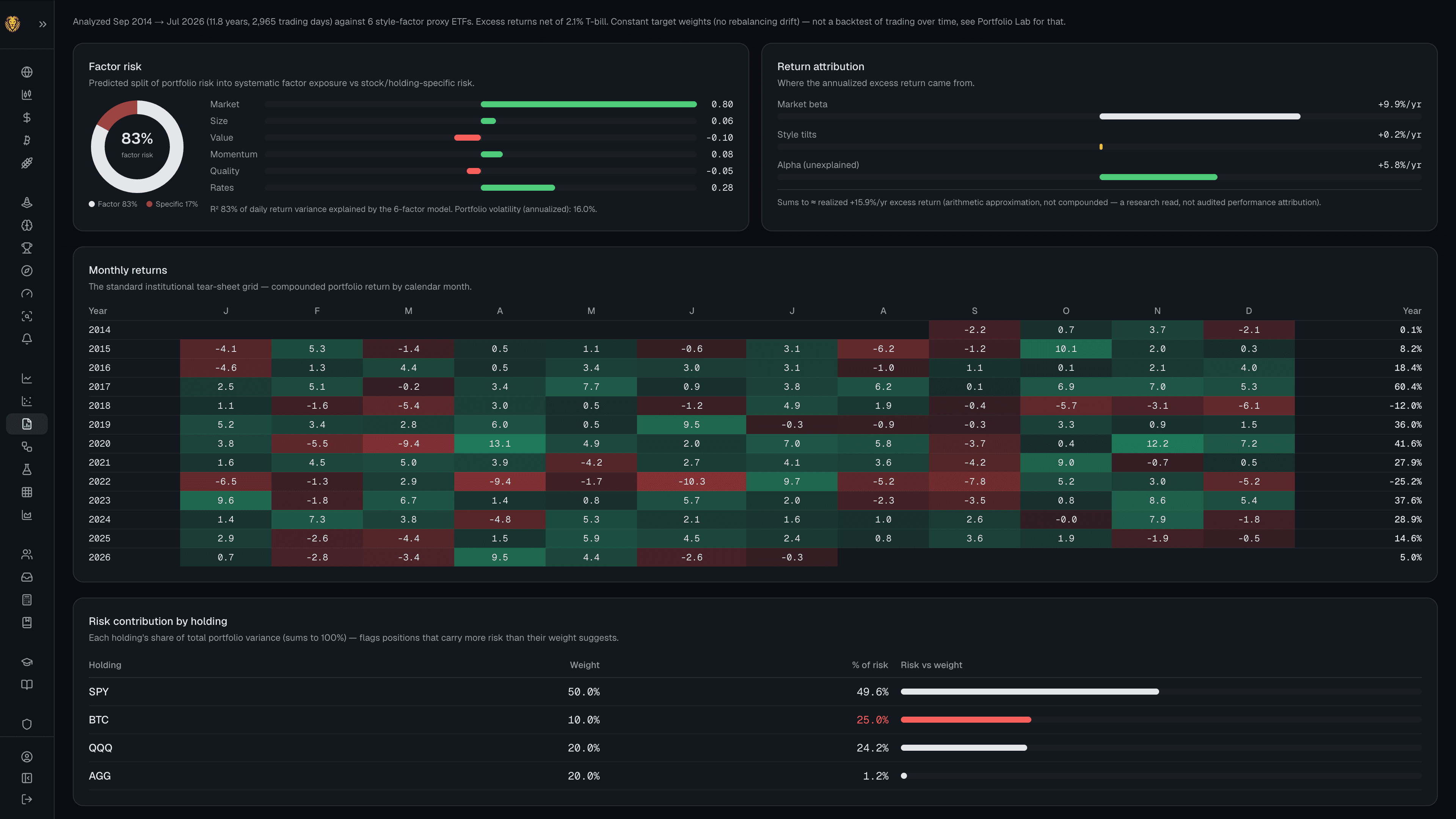
See where the return — and the risk — actually came from
An institutional tear sheet: split returns into market beta, style tilts, and alpha; break risk into six style factors and per-holding contribution; read the monthly-return grid across more than a decade.
- Factor risk — market, size, value, momentum, quality, rates
- Return attribution: beta vs style vs alpha
- Monthly-returns grid + risk-by-holding (MCTR)
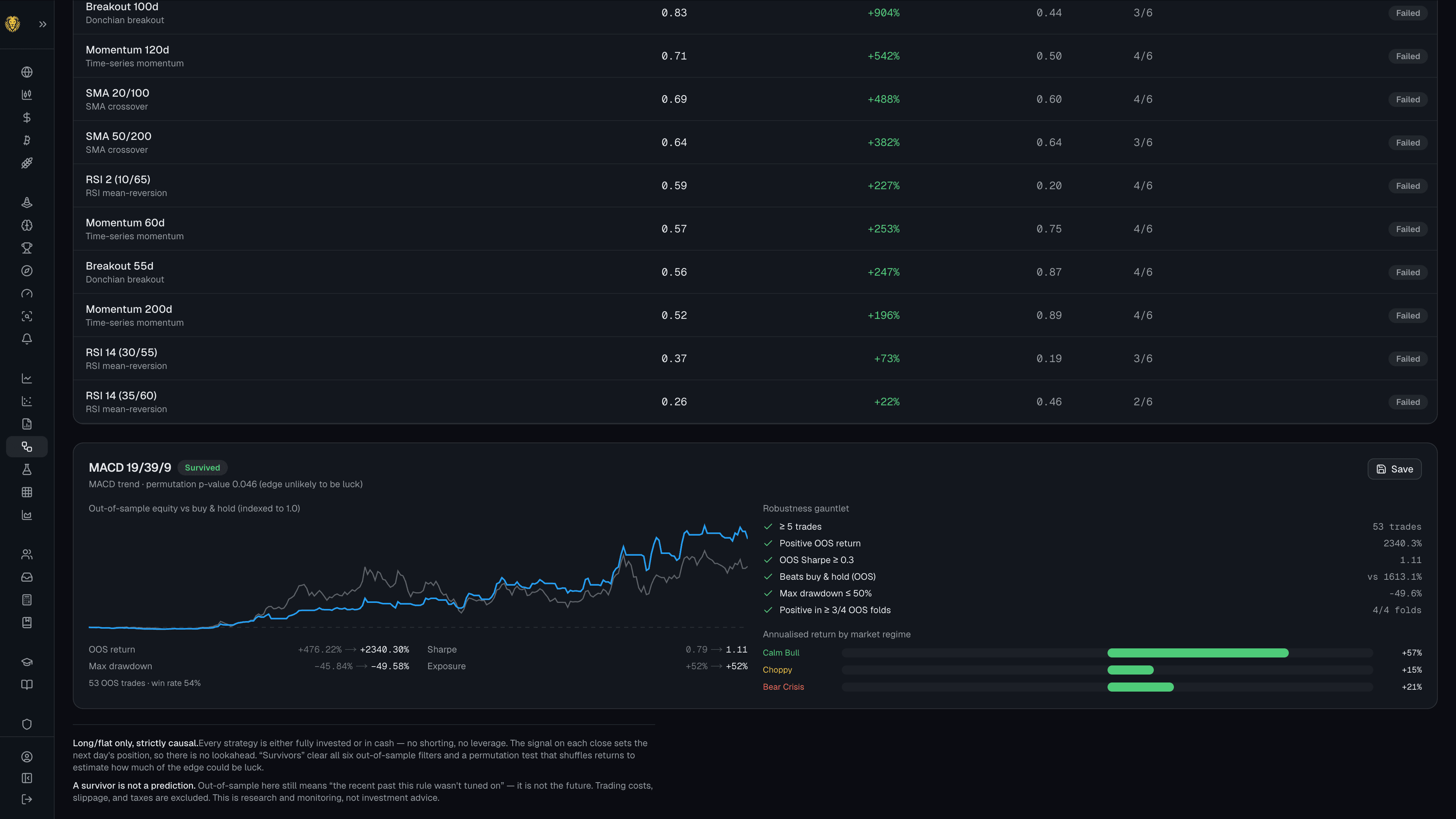
Find rules that survive out-of-sample — not curve fits
Run a funnel of long/flat rules through a six-filter robustness gauntlet and a permutation test that shuffles returns to estimate how much of the edge could be luck. Only survivors clear all of it.
- Out-of-sample split + permutation p-value
- Six-filter robustness gauntlet
- Regime-aware returns — calm bull / choppy / bear crisis
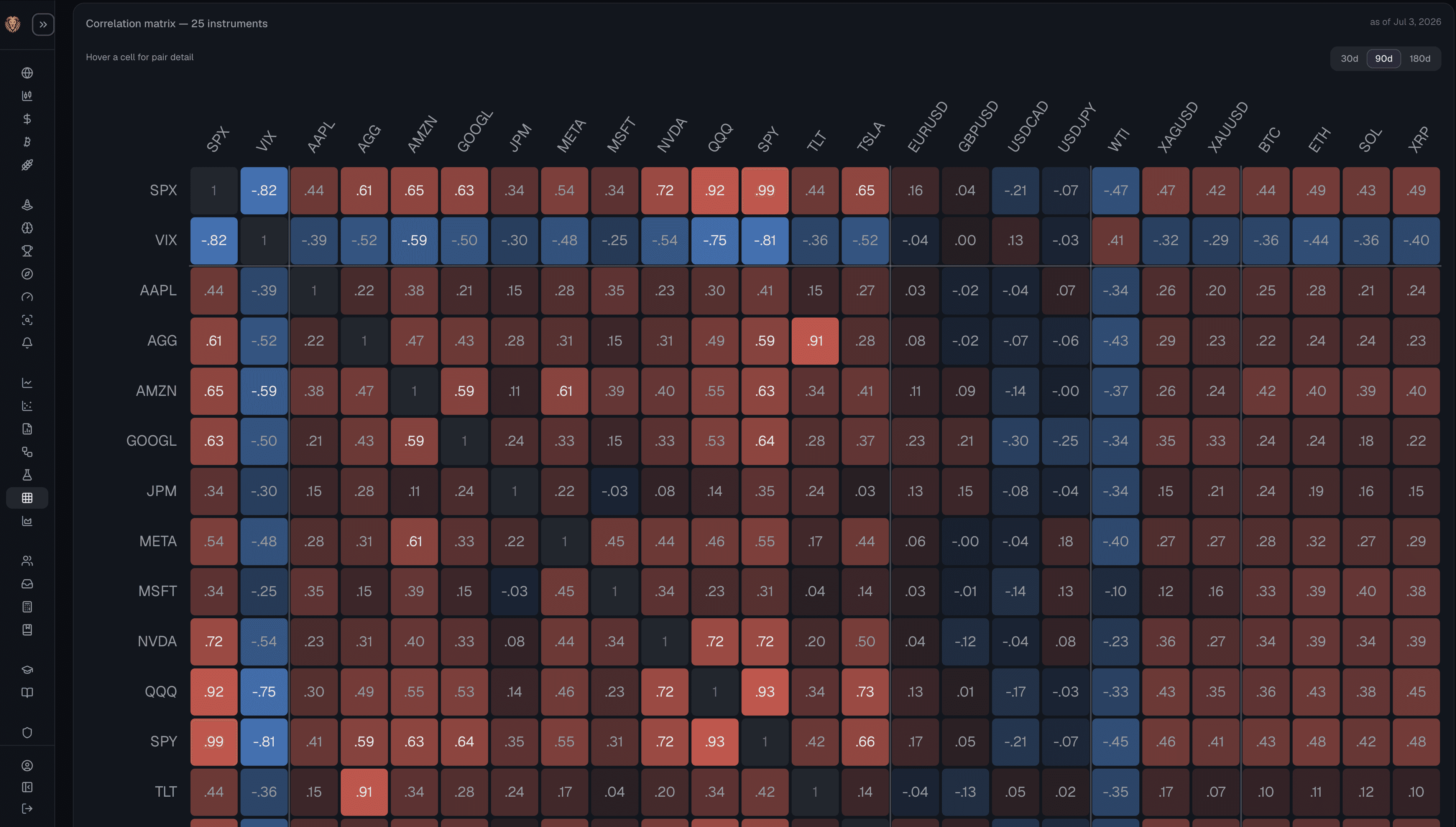
See concentration before it bites
A live cross-asset correlation matrix and a multi-factor opportunity board surface where your risk is really concentrated across the entire universe.
- Cross-asset correlation heatmap
- Multi-factor monitoring
- Technical & sentiment context
One workspace, the whole market
Thirty connected modules — from a fund foundry, a public decay board and a portfolio genome to a Claude analyst, a regime gate, cross-asset intel, earnings-drift base rates, TradingView-style charts, and per-client risk — so analysis, monitoring, and portfolio construction never leave one place.
The Fund Foundry lets you build a rule, replay it over decades, then freeze and publish it — and every published fund is scored in the open on how much of its backtest actually survived. See the public leaderboard.
From total beginner to the science of investing.
47 plain-English lessons across three tracks — and every deeper one is grounded in real research you can check. No jargon, no sign-up required to read.

- 1
What is investing?
Investing means putting your money to work so it can grow over time.
- 2
Risk and reward
Bigger possible rewards almost always come with bigger ups and downs.
- 3
Your time horizon
How long until you need the money decides how much risk makes sense.
- 4
Don’t put all your eggs in one basket
Spreading your money across different things makes the ride smoother.
- 5
What’s in a portfolio?
A portfolio is just the collection of things you own, plus any cash.
- 6
Build your first portfolio
Finisdom can turn your goals into a smart starter mix in a few clicks.
- Browse all 47 lessons
Become a founding member
One price, paid once, for everything — forever. The founding cohort is how Finisdom gets off the ground, so it is small and it closes when the spots are gone.
Frequently asked
How do you pronounce “Finisdom”?
Fee-neez-dom — like “finesse” and “wisdom” fused into one word, not “finish-dom.”
What exactly is the founding offer?
A one-time payment for lifetime access to Finisdom — the whole cockpit, every future update, no subscription ever. Founding pricing is tiered and climbs as seats fill: $200 for the first 20 members, then $350 through seat 50. Once all 50 founding seats are gone, lifetime access closes and standard pricing begins at $1,000 one-time or $250/year — which founders never pay. Your founding price is locked the moment you join.
Why so cheap for lifetime access?
Because it is early. Finisdom is a working beta with rough edges, and founding members are trading that for a forever price and real influence over what gets built. That is also why the founding price rises as seats fill and closes for good at 50 — the earliest believers get the best price.
Is this investment advice?
No. Finisdom is an analysis and monitoring tool. It never executes orders and never tells you what to buy or sell — every plan it builds is a simulation for your own decision-making. Backtests are hypothetical illustrations, not predictions.
What assets does it cover?
Equities and ETFs, high-yield and investment-grade credit, major crypto, FX pairs, commodities, and key indices — all in one place, so you can analyze and stress-test the whole portfolio together.
Does Finisdom track prediction markets?
Yes. The Macro Overview page shows real-money implied probabilities from Kalshi prediction markets for events like the next Fed decision, inflation, and recession — reported as what the market is pricing, never as our own forecast.
What is the Weekly AI Macro Brief?
A short brief Claude writes every week from Finisdom’s own deterministic readings — the deployment gate, market regime, valuation, positioning, and prediction-market odds — read out in plain English. It states conditions and historical base rates, never a price prediction, and it is not investment advice.
Can Finisdom connect signals across different assets?
Yes — that is what the Macro Intel page does. It tracks a dozen economically-linked pairs (gold vs real yields, credit vs stocks, the dollar vs emerging markets, and more) and flags the ones that have pulled apart from their own three-year norm, with the historical base rates of what followed past episodes. It also tracks the four major central banks and the Caldara–Iacoviello geopolitical-risk index, and a daily Claude synthesis reads the whole picture in plain English.
Can I see what happened after past earnings surprises?
Yes. The Earnings Drift page pools every quarter the tracked companies have reported since 2008 — pulled straight from SEC filings — and buckets them by how far the result sat from the same quarter a year earlier, measured in that company’s own standard deviations. Each bucket shows what the price actually did over the following 5, 21, and 63 sessions against the unconditional drift, with the sample size on every cell. It describes what history did, never what will happen next.
Does Finisdom track hedge-fund 13F filings?
It tracks ten concentrated, actively-managed funds — Berkshire, Pershing Square, Baupost, Appaloosa, Tiger Global and others — showing their largest positions and what they opened, exited, added or trimmed since the prior quarter, plus where any of it overlaps your own holdings. Index giants like BlackRock and Vanguard are deliberately excluded: they hold nearly every listed name by mandate, so their positions carry no decision. A 13F is filed up to 45 days after quarter end and covers only long US equity, so it is what a manager held, never what they hold today.
Does it tell me anything about my own decision-making?
Once you have logged and graded enough calls, the Decision Journal’s coach reads your own history for behavioural patterns — whether your conviction actually tracks your results, which side of the book carries you, the names you keep going back to. It stays closed until there are fifteen graded decisions, because a confident read of four would be pattern-matching noise. It describes your past decisions and never recommends a trade.
Does the AI review my whole portfolio, or just single stocks?
Both. The Claude analyst covers individual instruments, and a separate whole-book review reads an entire client portfolio at once — beta, concentration, exposure, and drift from the agreed mandate — and writes up the risks in plain English. Like everything else in the cockpit, it describes conditions rather than recommending trades.
Where does the data come from?
Public and licensed market and macro sources including FRED, SEC EDGAR, CFTC, and Kalshi. Performance figures shown here are hypothetical, backtested illustrations.
Is there a money-back guarantee?
Yes — 14 days, no strings. Email support@finisdom.com within 14 days of your access link arriving and we refund the founding payment in full. The 14 days start when you actually get in, not when you pay, so a slow week does not eat your trial. You get the entire cockpit during that window, not a limited demo. The beta terms spell out the details.
What does “lifetime” mean?
Lifetime means as long as Finisdom runs, your founding access never expires and never gets a recurring bill — one payment, every future update included, and the founding price is locked for life even after the public price rises.
Get in while it's $200 for life
The founding cohort is capped at 50, and the price climbs as seats fill. Claim your spot and lock in lifetime access to the whole multi-asset cockpit — with 14 days to change your mind and take the money back.
14-day money-back guarantee